

Information
This page allows you to discover the specifics of football predictions.
Is it possible to predict the outcome of a match?
Football is often seen as one of the most unpredictable sports. Equalising goals in the final minutes, red cards, own goals, injuries: all elements that can change the course of the game in an instant. Yet experienced analysts know that even these seemingly random moments follow a certain logic. Behind every goal lies a series of decisions and events, from player positioning to a defensive error. It is therefore possible to predict the result of a match by carefully interpreting its signals, analysing the context, and avoiding reliance on superficial impressions.

How to start a prediction?
A reliable prediction is based on rigorous analysis rather than intuition. The first step is to study the teams in detail. This goes beyond general statistics: recent results, squad changes, form of key players, injuries, and fixture congestion must be examined. Internal team factors are just as crucial: group atmosphere, relationships with the coach, motivation for the competition, as well as public statements from players. A poor performance can sometimes be explained by deeper reasons than just having an “off day.”
Tactics, more than just a formation
Tactical models determine the style of play, and their clash shapes the character of the match. For example, a team playing a 3-5-2 formation typically focuses on midfield control and wing strengths. In contrast, the 4-4-2 formation represents a classic game structure with minimal risk. The forecaster must consider not only the nominal formation but also the teams’ ability to adapt it to their opponent. It often happens that a team with flexible tactics defeats a stronger opponent precisely because of its ability to reorganise.
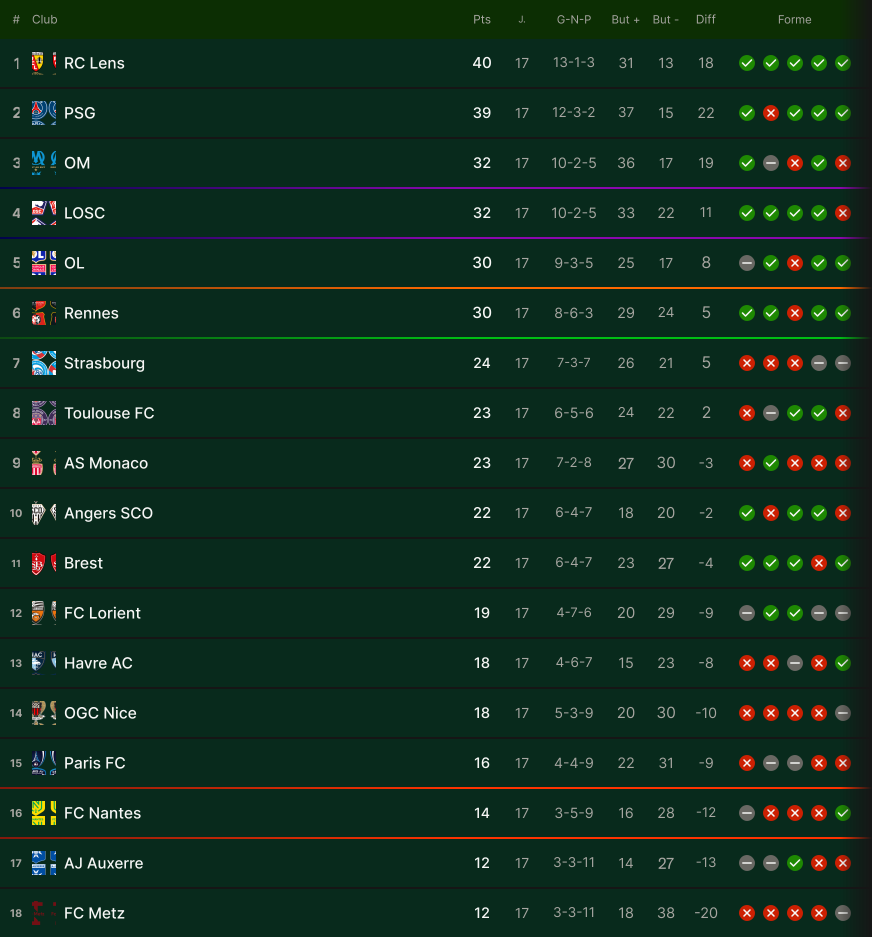
Championship — Ligue 1 (2025/26)

Motivation, a determining factor
Motivation is an essential psychological element. Even the strongest clubs adapt their play depending on the importance of the match. A decisive Champions League game is nothing like an ordinary mid-table encounter. An underdog fighting for survival can often cause an upset. That is why professional analysts always consider the context: is it the final day? Has the team lost all chances of qualification? Is the match crucial for the coach or captain?
Physical condition and workload
A busy schedule, simultaneous participation in multiple competitions, frequent travel: all these affect endurance. A team that has just played a tough away match may be tired both physically and mentally. In predictions, it is important to consider fixture congestion, possible squad rotation, and bench depth. Even minor injuries or fatigue of key players can influence the result.
Common mistakes made by beginners
The most common mistake is focusing on apparent favouritism. A winning streak, a high league position, or the reputation of an opponent can give an impression of advantage. But on deeper analysis, it becomes clear these wins were against weak teams or the top scorer was absent. Conversely, blindly trusting statistics without considering the current situation is also a mistake. True analysis is not limited to numbers; it involves understanding them and confronting them with reality.